
It is worth seeing a hair transplant specialist once thinning changes how your hair looks and styles, not just how much falls out. A widening parting, temples that keep creeping back or a crown that shows under bright light are all good reasons to book. The first consultation is simply an assessment: your history, a close look at your scalp and donor hair, and an honest plan.
Below are the signs worth noticing, followed by what really happens when you sit down with a specialist for the first time.
What are the early signs of pattern hair loss?
Pattern hair loss is gradual, so it often shows up in styling moments before you notice it in the mirror. Watch for these changes:
- A widening parting. The line where you part your hair looks broader than it used to, especially towards the front.
- Receding temples. The corners of the hairline move back, and a fringe or quiff no longer sits the way it did.
- More scalp in photos or bright light. Flash, overhead spotlights or a ring light reveal scalp you had not noticed before.
- A thinner ponytail. Your usual hair tie suddenly needs an extra twist to hold.
- A crown that shows. You catch the top of your head in a lift mirror and see more skin than expected.
Men tend to notice the temples and crown first. Women more often notice the parting and overall volume, while the front hairline usually stays in place.
Is losing hair in the shower or on your brush a warning sign?
Not always. Everyone sheds some hair each day as part of the normal growth cycle. Heavier shedding can follow illness, stress, childbirth or a big change in diet, and it often settles by itself.
A change in pattern or density over several months matters more. If the same areas keep looking thinner, or shedding does not settle, it is worth having a proper assessment.
Sudden, patchy or very fast hair loss is different. Have it checked by a doctor promptly, because it can have causes that need medical attention first.
Is it ever too early or too late to book a consultation?
An assessment is useful at almost any stage. Booking early gives you a baseline and a clear explanation, even if the advice is simply to keep an eye on things.
Early does not always mean surgery, though. When hair loss is still developing quickly, especially in younger people, specialists are often cautious, because the final pattern is not yet clear.
Nor is it usually too late. Even advanced thinning can be assessed, and what matters most is how much healthy donor hair is left at the back and sides.
What happens at a first hair transplant consultation?
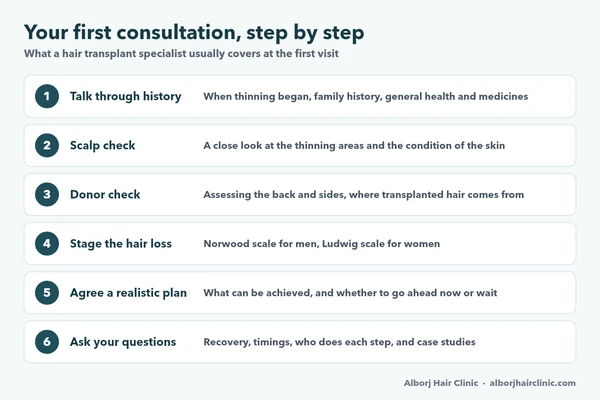
A good first consultation is mostly listening and looking. It usually follows a clear order:
- Your history. When the thinning started, how fast it has changed, family history, general health and any medicines you take.
- A scalp check. The specialist looks closely at the thinning areas and the condition of the skin.
- A donor check. The back and sides of the head are assessed, because this is where transplanted hair comes from.
- Your stage. Men are usually placed on the Norwood scale. Women are placed on the Ludwig scale, which has three grades.
- A realistic plan. You discuss what can be achieved, what cannot, and whether a transplant suits you now or later.
“At a first consultation I spend most of the time asking questions and examining the scalp, especially the donor area. Only then can we talk honestly about what a transplant can achieve. Sometimes the right answer is to wait.”
Will the specialist always recommend a transplant?
No, and that is a good sign. A transplant suits people with stable, patterned hair loss and enough healthy donor hair. If your loss is very early, changing fast or has an unclear cause, a doctor may suggest other options first.
A thoughtful plan also looks ahead. Once established, transplanted follicles normally carry on growing for life, while the surrounding original hair can still thin with age. A careful surgeon designs the hairline with that in mind, so it still suits your face in years to come.
If a transplant is right for you, the technique will be explained at this stage. With DHI (Direct Hair Implantation), follicles are taken out one by one and placed straight into the thinning area with an implanter pen. The procedure takes place under local anaesthesia.
What questions should you bring to your first consultation?
Write your questions down beforehand, because it is easy to forget them in the moment. Useful ones include:
- What stage is my hair loss, and is it likely to keep changing?
- Is my donor hair strong enough for a transplant?
- Who will perform each step of the procedure?
- How will the hairline suit my face as I get older?
- What will recovery involve, and when will I see results?
- Can I see case studies of patients with hair like mine?
Expect clear answers on timing. Transplanted hairs often shed in the first few weeks. Fresh growth usually appears at around three months, and the full result shows at around 12 months.
Bring a list of any medicines you take and a few notes on when you first noticed the changes. Style your hair as you usually do, so the specialist sees it as it looks day to day.
About Alborj Hair Clinic
Alborj Hair Clinic is a hair transplant clinic in Mazaya Centre, Al Wasl, Dubai. Its surgeon, Dr Dimitrios Ziakas, has 24 years of experience and has performed more than 4,000 hair transplant procedures. He is a member of the International Society of Hair Restoration Surgery (ISHRS) and uses the DHI (Direct Hair Implantation) technique.
Its website features before-and-after case studies, which can help you picture realistic results ahead of a first consultation.
Frequently asked questions
How early should I see a specialist about thinning hair?
As soon as you notice a steady change in your parting, temples or crown. An early assessment gives you a clear picture, even if no treatment is needed yet.
Does a consultation mean I have to book a procedure?
No. A consultation is an assessment, and you can take time to think about the plan afterwards.
Can women see a hair transplant specialist?
Yes. Thinning in women is staged on the Ludwig scale, and a specialist can check whether the pattern and donor hair suit a transplant.
What if I am not ready for a transplant yet?
That is fine. A consultation can simply give you a clear picture of your hair loss and a sensible point to review it again.
